

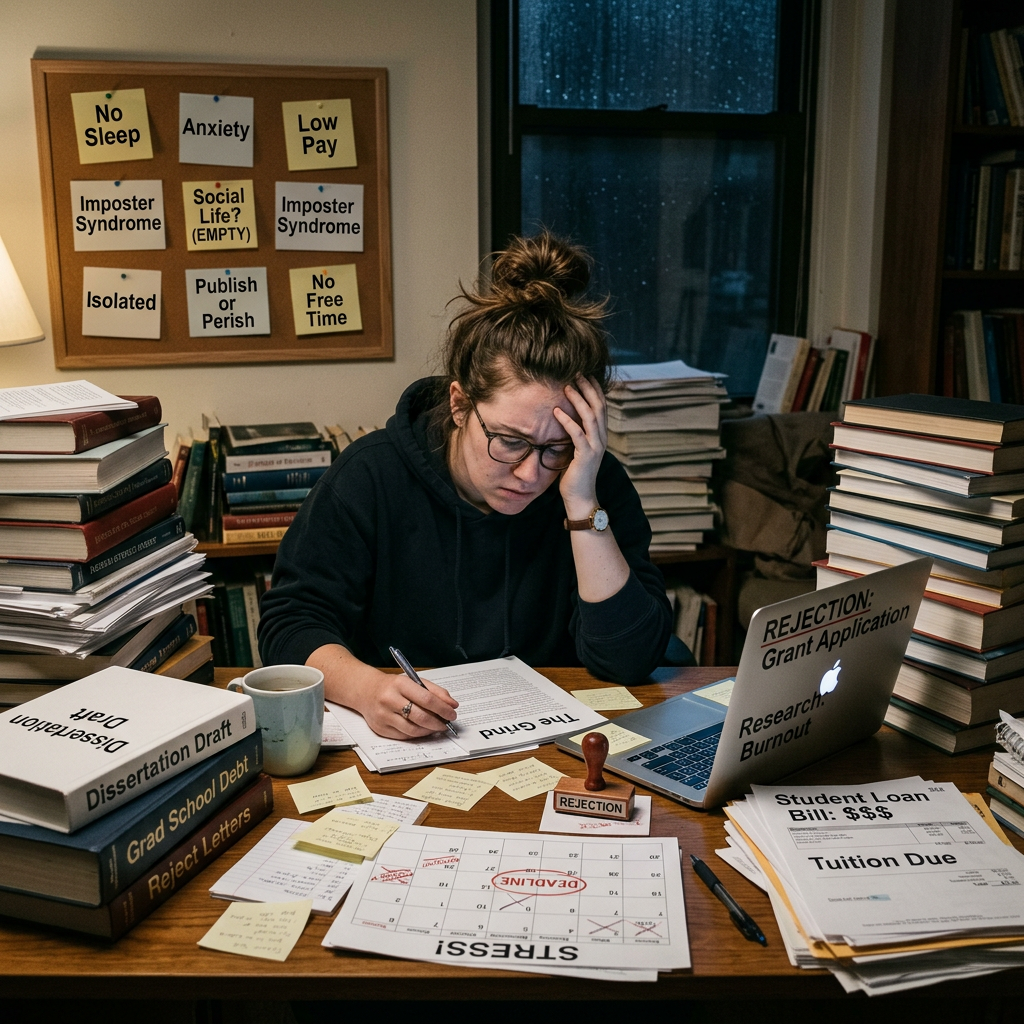
Finishing grad school is one of those moments that feels unreal. You walk out of your defense, turn in the final paperwork, hand in your keycard, and then suddenly everyone expects you to “bounce back” and immediately start the next chapter with perfect clarity and zero hesitation. For years you lived inside a world of deadlines, expectations, anxiety, imposter syndrome, and constant pressure. Then, without warning, it all stops.
And that silence can be loud.
If you’re anything like I was, you probably spent the first few days after graduating feeling both relieved and disoriented. I asked myself immediately “now what?”
It’s the same mental whiplash many people feel after finishing a marathon. Your body was trained to move at a certain pace for so long that slowing down feels wrong, or even dangerous, as if everything might collapse if you stop for even a second. Slowing down was the worst thing ever and gave me so much anxiety.
But here’s the truth: You are allowed to take time after grad school!!!! Not just allowed, you need it.
This post is a reminder that rest isn’t failure. Slowing down isn’t laziness. And reclaiming your life after years of academic hyper-focus is not only healthy, it’s essential. Life is more than work. Remember that.
The Pressure to “Move On” Immediately
One weird part about grad school is how quickly people ask what’s next. Before you’ve even walked out of your committee room, someone is already asking:
“So what’s your plan now?”
“Are you applying to jobs?”
“Are you going into industry?”
“Are you doing a postdoc?”
and my favorite “So when will you have that manuscript done so we can submit”
As if taking one single breath after years of work is unacceptable.
This mindset is part of the productivity culture so deeply ingrained in academia, a culture where rest is often treated as optional, self-care feels like a luxury, and slowing down is viewed as lack of ambition. We learn to measure our worth by output such as papers, data, manuscripts, publications, presentations, and grants.
Grad school is not normal life. And you’re not meant to jump from one intense environment into another without a chance to recover your mind, body, and identity.
In fact, psychologists consistently show that transitions, even positive ones, require decompression time. The American Psychological Association has excellent research on recovery after long periods of stress.
Whether you finished a master’s program, a PhD, or a professional degree, you spent years carrying a workload that most people will never fully understand. You earned a pause.
The Mental Reset You Probably Never Gave Yourself
I’ve written before about the emotional weight grad school puts on people, especially when you feel like you’re supposed to handle everything alone. Posts like “Don’t Be Ashamed to Ask for Help in Grad School” highlight a truth most students quietly live with: we rarely let ourselves slow down enough to actually process what we’re going through.
After grad school, your brain needs time to unlearn survival mode.
Here’s what recovery looks like
1. Letting yourself feel proud.
So many people rush past the accomplishment. But finishing grad school is a major achievement. Take time to sit with that. In fact, take a ton of time. You have spent years to get to this point, and yes, it ends abruptly. But that doesn’t mean you need to move to the next thing immediately.
2. Rediscovering hobbies.
You probably abandoned things you loved. Fishing, hiking, cooking, reading non-academic books. slowly re-build those parts of your life.
3. Rebalancing your sense of identity.
For years, you were “the grad student.” Now you get to remember who you are outside of research.
4. Decompressing physically.
Long-term stress builds up in the body. Sleep, movement, and rest aren’t luxuries, they’re needed repairs.
5. Resetting your relationship with productivity.
You don’t need to be constantly doing something to be valuable.
The Fear of “Falling Behind”
One reason people don’t allow themselves downtime after grad school is fear. Fear of losing momentum. Fear of missing opportunities. Fear of not immediately having everything figured out.
But here’s the truth you don’t hear enough. You’re not behind, you’re transitioning.
Everyone’s timeline after grad school looks different:
Some get jobs immediately. Some take months to decompress before going into industry. Some start families. Some travel. Some do absolutely nothing for a while, and that is completely valid.
If you feel pressure to instantly “make up for lost time,” remember that academic burnout is real and cumulative. Without recovery, you simply carry it into the next job, the next role, the next chapter. That’s how long-term burnout happens.
For further reading, the Mayo Clinic’s breakdown on burnout is incredibly helpful:
You Don’t Need to Prove Anything Anymore
Grad school trains you to constantly prove yourself, to your advisor, committee, peers, program, and sometimes even to your own inner critic. After graduation, the instinct to justify your plans, your choices, your rest, and your timeline doesn’t disappear immediately.
But here’s a reality that takes a while to settle in:
You don’t have to prove anything to anyone now.
You’re not behind on emails, or late on a deadline. You’re not required to be “productive” every day.
You don’t owe anyone an explanation for resting.
You gave years of your life to earn a degree that demanded more of you than most people will ever understand. Let that be enough for a moment.
Relearning How to Enjoy Life
One of the biggest challenges after grad school is remembering how to enjoy life again.
You get so used to grinding through stress that peace feels suspicious.
So take time to reconnect with things that make you feel alive:
- Go on walks.
- Cook something slow.
- Spend time with the people you love.
- Take a weekend trip without packing work.
- Fish. Sit outside. Watch the water.
Even simple moments can feel like a full reset if you’ve been in survival mode for years.
I wrote about this in “When I am Stressed”:
Give Yourself Permission to Do Nothing
Here’s your permission slip:
You are allowed to rest without guilt.
You don’t need to immediately start a job.
You don’t need to immediately choose a career.
You don’t need to immediately be “impressive.”
Taking time after grad school is important and gives you a chance to heal, regorup, rest, and think about the next chapter of life, whatever that may be.
What Taking Time Actually Looks Like
Here are some real, practical ways to give yourself space after grad school:
1. Schedule intentional recovery time
Not just a weekend. Give yourself a real break such as a few weeks or months.
2. Build small routines
Light exercise, morning coffee outside, quiet time, journaling, or mindful breathing.
3. Reconnect with people you neglected during crunch seasons
Grad school makes relationships difficult. Rebuilding them takes time.
4. Allow boredom
This is where creativity comes back. Where identity rebuilds itself.
5. Reassess what success now means to you
You’re no longer trapped in academic metrics. Redefine your goals in your own language.
You Deserve a Pause
You spent years pushing through anxiety, deadlines, expectations, and impossible standards. You earned the right to breathe. And when you finally give yourself that space, you’ll be able to step into the next chapter of your life not as a stressed-out student trying to survive, but as a whole person ready to choose what’s next with clarity.
Take the time. You need it. You deserve it.

Leave a Reply